This is not normally within the scope of this blog but felt it was important enough to take a stab at to get a better idea of what is really going on in the Middle East.
On November 10th 2005, an article described one of the unspoken reasons why the United States had to invade Iraq: to liberate the U.S. dollar in Iraq so that Iraqi oil could once again be purchased with the petrodollar. See The liberation of the U.S. Dollar in Iraq.
In November 2000, Iraq stopped accepting U.S. dollars for their oil. Counted as a purely political move, Saddam Hussein switched the currency required to purchase Iraqi oil to the euro. Selling oil through the U.N. Oil for Food Program, Iraq converted all of its U.S. dollars in its U.N. account to the euro. Shortly thereafter, Iraq converted $10 billion in their U.N. reserve fund to the euro. By the end of 2000, Iraq had abandoned the U.S. dollar completely.
Two months after the United States invaded Iraq, the Oil for Food Program was ended, the country’s accounts were switch back to dollars, and oil began to be sold once again for U.S. dollars. No longer could the world buy oil from Iraq with the euro. Universal global dollar supremacy was restored. It is interesting to note that the latest recession that the United States endured began and ended within the same timeframe as when Iraq was trading oil for euros. Whether this is a coincidence or related, the American people may never know.
In March 2006, Iran will take Iraq’s switch to the petroeuro to new heights by launching a third oil exchange. The Iranians have developed a petroeuro system for oil trade, which when enacted, will once again threaten U.S. dollar supremacy far greater than Iraq’s euro conversion. Called the Iran Oil Bourse, an exchange that only accepts the euro for oil sales would mean that the entire world could begin purchasing oil from any oil-producing nation with euros instead of dollars. The Iranian plan isn’t limited to purchasing one oil-producing country’s oil with euros. Their plan will create a global alternative to the U.S. dollar. Come March 2006, the Iran Oil Bourse will further the momentum of OPEC to create an alternate currency for oil purchases worldwide. China, Russia, and the European Union are evaluating the Iranian plan to exchange oil for euros, and giving the plan serious consideration.
If you are skeptical regarding the meaning of oil being purchased with euros versus dollars, and the devastating impact it will have on the economy of the United States, consider the historic move by the Federal Reserve to begin hiding information pertaining to the U.S. dollar money supply, starting in March 2006. Since 1913, the year the abomination known as the Federal Reserve came to power, the supply of U.S. dollars was measured and publicly revealed through an index referred to as M-3. M-3 has been the main stable of money supply measurement and transparent disclosure since the Fed was founded back in 1913. According to Robert McHugh, in his report (What’s the Fed up to with the money supply?), McHugh writes, “On November 10, 2005, shortly after appointing Bernanke to replace Greenbackspan, the Fed mysteriously announced with little comment and no palatable justification that they will hide M-3 effective March 2006.” (Click here to learn more about Robert McHugh's work.)
Is it mere coincidence that the Fed will begin hiding M-3 the same month that Iran will launch its Iran Oil Bourse, or is there a direct threat to the stability of the U.S. dollar, the U.S. economy, and the U.S. standard of living? Are Americans being set up for a collapse in our economy that will make the Great Depression of the 1930’s look like a bounced check? If you cannot or will not make the value and stability of the U.S. currency of personal importance, if you are unwilling to demand from your elected officials, an immediate abolishment of the Federal Reserve Act of 1913 and the fiat money scheme that the banking cartel has used for nearly a century now to keep our government and our people in a state of perpetual debt, than you are faced with but two alternatives, abject poverty, or invading Iran.
The plans to invade Iran are unspoken, but unfolding before our very eyes. The media has been reporting on Iran more often, and increasingly harshly. For the U.S. government to justify invading Iran, it must first begin to phase out the War in Iraq, which it is already doing. Next, it must portray the Iranian President, Mahmoud Ahmadinejad, as a threat to the region and the world. Finally, once naive American people are convinced the “weapons of mass destruction” that were to be found in Iraq are actually in Iran, coupled with the almost daily media coverage of Iran’s nuclear power / weapons program aspirations, and what we will soon have on our hands is another fabricated war that will result in tens of thousands of civilian lives being lost, all because the political elected pawns in Washington DC lack the discipline to return our currency to a gold or silver standard, end the relationship with the foreign banking cartel called the Federal Reserve, and limit the activities of the U.S. government to those articulated in Article I Section 8 of the Constitution for the United States of America.
When a wayward and corrupt fiscal policy and fiat currency, coupled with runaway government spending, forces a nation to only be able to sustain the value of its currency with bullets, the citizenry of the country involved in wars primarily to sustain its currency have historically first became slaves to their government, and then to the nations that finally conquer them. If you question the validity of such a premise, or whether it could happen to the United States of America, study the fall of the Roman Empire. If you read the right books on the subject, you’ll quickly discover that towards the end of the Roman reign, the Roman Empire was doing exactly what America is doing today; attempting to sustain a failed fiat money system with bullets.
Understanding fiat money is not an easy task, and the Federal Reserve, World Bank, and International Monetary Fund have purposely made it that way. They do not want the American people to realize that the money in their wallet loses its value with each new dollar that they print. They do not want people to understand that our money does not become money until it is borrowed. When the Federal Reserve has money printed, when it is in uncut sheets of paper, it is not yet money. After it is cut, bundled, and placed into the Federal Reserve vaults, it still is not money. It only becomes money once it is borrowed. Consequently, if all debt were to be paid, if the United States didn’t have an $8 trillion national debt and the American people were debt free, and if all loans of U.S. dollars made to foreigners were paid in full, there would be exactly zero U.S. dollars in circulation because it will have all been returned to the vaults of the Federal Reserve. This might seem hard to fathom, but it is the gospel of fiat money.
The major news media in the United States, fed by Washington DC which in turn is fed by the Federal Reserve, literally, has already begun conditioning the American people for invading Iran. Media accounts of Iran’s nuclear ambitions along with amplification of the potential instability and core evilness of Iran’s president, Mahmoud Ahmadinejad, is setting the stage to spring the invasion of Iran on the American people. There does appear to be a direct correlation between the winding down effort underway in Iraq and the increase of anti-Iran rhetoric. How American soldiers ultimately arrive in Tehran is uncertain at this time, but it is reasonable to expect that if the Iran Oil Bourse opens for business in March 2006 as planned, it will only be a matter of time before the United States will have to blow it up.
If the United States invades Iran, or if Israel starts military actions by launches missiles at Iran’s nuclear power facilities, which then opens the door for the United States to intervene, most Americans will believe that our military actions in Iran will be to defend freedom and liberty while spreading democracy, when the truth is that we’ll be fighting a war in Iran because of our nation’s relationship with the Federal Reserve, a so-called bank that is not owned by the federal government, maintains no reserve, and isn’t a bank at all, but a cartel. Just like our war in Iraq, Americans and foreigners will die in battle so that the historical power bankers and brokers; cartel members such as Rothschild, Morgan, Lehman, Lizard, Schrader, Lobe, Kuhn, and Rockefeller to name a few, can continue collecting interest on every single U.S. coin and dollar bill in circulation, while controlling the U.S. Congress to the extent that the U.S. taxpayer becomes the collateral and lender of last resort to cover bad loans and unpaid debts that these institutions create by loaning money to third world countries, some of which are devout enemies of the United States. Remember the $400 billion savings & loan bailout approved by the U.S. Congress during the Reagan Administration? America is still paying for it – you and me, and so will our children and grandchildren.
It is well overdue for Americans, every American, to do whatever it takes to fully understand the relationship between the United States and the Federal Reserve, along with the grave consequences of our current fiat money system; for even if the United States wanted to continue to sustain the supremacy of the U.S. dollar with bullets, it is historically, impossible. When bullets become the commodity to secure a currency, it is a clear sign of devastating calamity looming. To ignore the warning signs, is to suffer like you have never suffered before, or to die. Harsh words, but true.
Source
Showing posts with label Israel. Show all posts
Showing posts with label Israel. Show all posts
Tuesday, June 19, 2007


Wednesday, May 02, 2007
The Right to Strike
 Something very interesting from haaretz.com regarding the U.S.'s secret plan to attack Israel in 1967 to prevent Israel from expanding westward, into the Sinai, or eastward, into the West Bank.
Oh, what a different world we would be in had they implemented the plan...and what a different life I would have had...in my home in Jerusalem!!
--------------------
The right to strike
By Amir Oren
The end of the story is known: During the Six-Day War, no battles were waged between the Israel Defense Forces and the United States. True, the American spy ship "Liberty" was attacked by mistake, but neither side initiated exchanges of fire. What is not known - and because of it, the story is riveting nevertheless - took place in the background. For some time, the United States had had an emergency plan to attack Israel. In May 1967, one of the U.S. commands was charged with the task of removing the plan from the safe, refreshing it and preparing for an order to go into action. However, the preparations lagged behind the developments in the diplomatic arena, and even further behind the successes of Israel's air force and armored divisions in Sinai. The general who was planning to attack Israel made do with extricating frightened American citizens and a panic-stricken ambassador from Jordan. This unknown aspect of the war was revealed in what was originally a top-secret study conducted by the Institute for Defense Analyses in Washington. In February 1968, an institute expert, L. Weinstein, wrote an article called "Critical Incident No. 14," about the U.S. involvement in the Middle East crisis of May-June 1967. Only 30 copies of his study were printed for distribution. Years later the material was declassified and can now be read by everyone, although details that are liable to give away sources' identities and operational ideas have remained censored. Strike Command, the entity that was to have launched the attack on Israel, no longer exists. It was annulled in 1971 for domestic American reasons and superseded by Readiness Command, which was abolished in the 1980s in favor of Central Command (CENTCOM) - which today includes forces in Iraq, Iran, Syria, Lebanon, Egypt, Jordan and Afghanistan - and the Special Operations Command (SOCOM).
The general who oversaw the planning in 1967 was Theodore John ("Ted") Conway. In Israeli terms, taking into consideration all the relevant differences, he can be likened to Avraham Tamir and Yuval Ne'eman, Aharon Yariv and Giora Eiland. Conway was a talented but forgotten officer, who did not leave a powerful impression on the history of the army that made use mainly of his brain; he did more participating than actual fighting in his generation's wars. His qualities as a curious and intelligent planner, a quick study who was creative in his solutions, led his commanders to assign him to headquarters and deprived him of the prospect of leading fighting forces. That didn't stop Conway from advancing through the ranks. In the last decade of his service he moved up quickly to the highest level - that of four-star general - at the age of 56, as head of Strike Command. It was in this last post, ahead of his retirement, that he served as the crisis of May 1967 unfolded. It was his last opportunity to see whether what he had conceptualized could truly be realized. 'Subway' soldiers Conway, who hailed from Indianapolis, described himself jestingly as one of the "subway" soldiers, as New Yorkers who enlisted to serve in World War II were sometimes described: short men, whose dimensions suited the crowding on the underground trains. He was a small, coiled spring, a physical fitness zealot. Every New Year's Day he made his officers take part in a 16-kilometer run, so that they would not spend the holiday watching television in a beer-induced stupor on the couch. In the 1930s he was sent to Paris to study France, its language and culture, in order to return to West Point and teach the cadets about them. His exposure to Europe peeled away the provinciality that characterized the American officer corps at that time. During World War II, in the course of his service in North Africa, Italy and France - sometimes as an interpreter and liaison between the U.S. and British forces, and between both of them and the French forces - Conway acquired expertise and an understanding of the complexities of security and diplomacy on both shores of the Mediterranean. If the U.S. Army was going to have to act in the Middle East, there was no officer more suited than him to command the forces in the period of the Six-Day War. As a 30-year-old captain at the start of the American involvement in the world war, Conway volunteered for the paratroops, but was disqualified because of his age. A decade later, after two years in military colleges, he discovered that the only way to avoid being assigned to a desk job in the Pentagon was to volunteer for the paratroops. He tried again, and this time, as a colonel of 40, he was given command of a brigade. In October 1961, when President John Kennedy paid a visit to Fort Bragg, the headquarters of the paratroopers of the 82nd Airborne Division and of the Special Forces, the then 50-year-old Conway was already the commander of the division, had parachuted with his troops and marched back to base with them in a trek of 135 kilometers. His deputy, Ed Rowny, later recalled the presentation Conway prepared for Kennedy: He divided the division into five units and dressed each of them in a different uniform, in order to demonstrate the division's flexibility to carry out missions anywhere in the world. One group was in standard battle fatigues, ready to be airlifted to Europe; a second was in jungle camouflage fatigues, ready to deploy to Vietnam; a third wore desert camouflage fatigues; a fourth wore winter uniforms of the Korean War type; and the fifth, equipped with skis and wearing white ski suits, was available for Arctic operations. Within a few months, Conway's clever presentation of worldwide readiness sparked an imitation. At MacDill Air Force Base, near Tampa, Florida, the headquarters of Strike Command, an officer demonstrated for the camera of the ground forces monthly journal Army just how ready every soldier there was for any mission anywhere: They had not one duffle bag and not two, but three: one Arctic, one tropic, one miscellaneous. more...
Tuesday, March 06, 2007
Hot Winter
My friend Lucy, has been MIA for a while...last I heard she was back in Nablus. And then all of this:
Tell me this DOESN'T remind you of stormtroopers during WWII...I hope she's alright.
Thursday, February 08, 2007
Israel and the Media: The Ten Commandments

Well, considering that the subject of my last post barely made the news this week, here are ten rules everyone should memorize before watching the evening news or reading the morning paper. They make everything perfectly clear:
Rule # 1: If the story is about the Middle East, the Arabs always attack first and Israel always defends itself. This is called "reprisals".
Rule # 2: Arabs, Palestinians or Lebanese have no right to kill the soldiers or civilians of the other side. This is called "terrorism".
Rule # 3: Israel can kill civilian Arabs. This is called "legitimate self-defence".
Rule # 4: When Israel kills too many civilians, the West asks Israel to be more "proportionate" in its attacks. This is called "the reaction of the international community".
Rule # 5: Palestinians and Lebanese are not allowed to capture Israeli soldiers, even if it’s only three soldiers, since this would pose "an existential threat to the state of Israel".
Rule # 6: Israelis have every right to kidnap as many Palestinians as they like. They now have approximately 10,000 such prisoners, including 300 children. There is no limit to the number that can be kidnapped and no need to prove the guilt of the kidnapped individuals. It is enough to use the magic word "terrorist" and that settles the matter.
Rule # 7: When you say "Hezbollah", you must always add the words "Islamists", "Shiites" and "backed by Syria and Iran".
Rule # 8: When you say "Israel" you must not add "the Jewish State" or "the Jewish army" and above all must not use the words "backed by the United States, France and Europe" since this implies an unequal conflict.
Rule # 9: Never mention the "occupied territories" or UN resolutions except for Resolution #1559, which called for the disarming of Hezbollah. And do not mention violations of international law or of the Geneva Conventions. This upsets TV viewers and radio listeners by forcing them to think.
Rule # 10: Israelis speak better English than Arabs. This is why we give them and their defenders as much time as possible to speak on the air. This allows them to help us better understand Rules # 1 - 9.
And this is what is called "journalistic neutrality".
Written by Sabri Khayat
Thanks to PAJU Montreal
Tuesday, January 23, 2007
Jewish Like Me
 McGill University is one of the bigger University's in Canada and it's campus is here in Montreal. It may actually qualify as an "Ivy League" school. I was going through the McGill Daily paper online and came across this story, "Jewish Like Me" written by Jesse Rosenfeld, a Toronto transplant.
It's a very good article that illustrates the dichotomy of what it is to be a Jew from a North American perspective. As a Palestinian forced to leave his home I am encouraged by this public display of condemnation of Israel's violent past and a call for justice for the Palestinian people.
Here's part of the article:
"Like most kids growing up Jewish, I loved Israel. I identified with the country and saw my Jewish identity expressed in it.>> Read More Here
Maybe it was because I found inspiration in an Israeli culture that seemed to focus on youth. I liked how David Ben-Gurion, Israel’s first Prime Minister, referred to the “New Israeli Jew” – strong, committed and independent – as opposed to the idea of a “European Jew” – weak, emasculated, and dependent. Or maybe I wanted to identify with something other than tedious family gatherings in Toronto complete with a grandmother who pinched my cheeks.
Either way, as a short, underweight early teen looking to find a form of community and feeling of empowerment, Israel and its image provided me with a feeling of masculinity. The Israeli myth allowed me to reject the stuffiness of North American Jewish culture while keeping a sense of an imagined community that was still accepted, and even encouraged, by my family and community.
As I explored this more, I began to realize that Zionism was synonymous with a violent colonization and occupation of another people."
Thursday, December 21, 2006
Montrealers Denounce Israeli Apartheid

Boycott Israeli Apartheid Banner in Downtown Montreal [Photo: Ron Saba Montreal Planet Magazine]
On Saturday, December 16th, 2006 Palestinian solidarity activists gathered on St. Catherine street in downtown Montreal to draw attention to a 2005 appeal from over 170 Palestinian civil-society organizations to, "Boycott, Divestment and Sanctions against Israel Until it Complies with International Law and Universal Principles of Human Rights."
Distributing information to curious Montrealers strolling downtown Montreal, members of the International Solidarity Movement [ISM] and Tadamon! appealed to curious onlookers to support the Palestinian call to boycott Israel.
Click HERE to Download / Listen to the report from EI.
This audio report was produced by Stefan Christoff of Tadmaon! for broadcast on CKUT Radio, 90.3fm in Montreal & Internet distribution through Electronic Intifada.
Tuesday, December 19, 2006
No More Taking Sides
 Once again I turn to a great radio show on NPR called Speaking of Faith. I heard the story of Robi Damelin who lost her son David to a Palestinian sniper and the story of Ali Abu Awwad who lost his older brother Yousef to an Israeli soldier. But, instead of clinging to traditional ideologies and turning their pain into more violence, they've decided to understand the other side — Israeli and Palestinian — by sharing their pain and their humanity. They tell of a gathering network of survivors who share their grief, their stories of loved ones, and their ideas for lasting peace. They don't want to be right; they want to be honest.
Listen to the show which runs about 53 minutes (.MP3 or Real Audio) and then feel free to comment.
I know that a re-United Palestine, secular and for all of it's people will not be easy, but it is something we NEED to do. It is the only way out of this mess...
Friday, December 15, 2006
Israel's High Court Legalizes Assassination
 Yup, Israel...(the only democracy in the Middle East) has just legalized assassinations of it's political opponents...nice, eh? Already some 500 Palestinians have been "sentenced" since the year 2000...now, it's legal well at least according to Israel's High Court. I just wanna know what they've been smoking.
Of course this decision will help all of those Israeli military officers in defending themselves against a slew of war crimes lawsuits filed against them in foreign courts.
Read the story
Tuesday, December 12, 2006
"Israel needs a wake up call": An interview with Ilan Pappe
When I ordered my copy of "ONE COUNTRY" Amazon suggested a second book to order at the same time and I did called,"The Ethnic Cleansing of Palestine" by Ilan Pappe. The link below is to an interview with Ilan Pappe by a fellow blogger Christopher Brown. Please take a moment to read it as an addition to my post ONE COUNTRY.
"Israel needs a wake up call": An interview with Ilan Pappe
Tuesday, December 05, 2006
ONE COUNTRY
 I truly believe that Palestine is meant to be an example to the world of 'unity': Unity of religion, language and a unity point of East/West culture and ideology. And I am glad to find out now that I'm not the only ONE.
I have just discovered the book ONE COUNTRY: A Bold Proposal to End the Israeli-Palestinian Impasse by Ali Abunimah, a fellow Palestinian now living in the US who among many things is a cofounder and editor of the website Electronic Intifada.
About the Book
As the Israeli-Palestinian conflict rages on with relatively new leadership on both sides, we are led to ask what has become a perennial yet only more urgent question -- will this conflict ever be resolved in a way that will finally bring peace to the region? This fall, Metropolitan Books published one of the most controversial approaches to a resolution. Noted expert on the topic and the son of Palestinians who fled the country in 1948, Ali Abunimah makes the radical argument that what is needed is one state shared by Palestinians and Israelis in his new book, ONE COUNTRY: A Bold Proposal to End the Israeli-Palestinian Impasse (Metropolitan Books; November 2006).
Clear-eyed, sharply reasoned, and compassionate, ONE COUNTRY revives an old and neglected idea of sharing the country. Although living together might seem impossible, Abunimah shows how Israelis and Palestinians are by now so intertwined -- geographically and economically -- that no kind of separation can lead to the security Israelis need or the rights Palestinians must have. He reveals the bankruptcy of the two-state approach, takes on the objections and taboos that stand in the way of a binational solution, demonstrates that sharing the territory will bring benefits for all, and asserts that the country can remain a homeland for both Jews and Palestinians. The absence of any other workable option can only lead to ever-greater extremism; it is time, Abunimah suggests, for Palestinians and Israelis to imagine a different future and a different relationship.
More urgent than ever, ONE COUNTRY is a provocative approach to the Israeli-Palestinian conflict, and one that is certain to cause a stir on all sides.
I believe it takes great courage to end the current cycle of: fear > hatred > war > terrorism > fear > hatred > war ....etc. The only way to get off this track is to try something different...a FREE and re-United Palestine, a secular country for ALL.
Buy the book in Canada
Buy the book in the U.K.
Buy the book in the United States

Monday, November 27, 2006
Israeli Apartheid Part 2
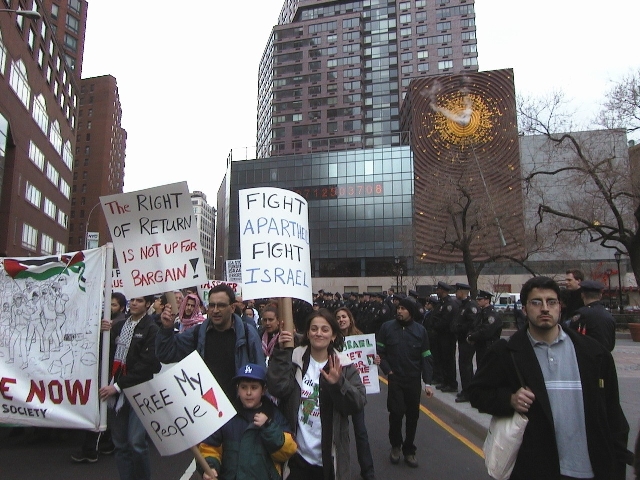
Before you read this post please read Part 1. It is important to get a full and complete understanding of the similarities and differences of the Israeli Apartheid versus the South African Apartheid. This article will deal with the DIS-similarities of the two, that said...read on!
First of all, what are key differences between South African apartheid and Israel’s policies toward its Palestinian citizens?
I will concede without a fight that in Israel, there is a lack of formalized separation of the kind practiced in apartheid South Africa. Another key difference is that while white South Africans sought to exploit the labour of the nonwhite community under apartheid, Israel has more often sought to displace Palestinians from as much of their land as possible and keep the land for Jewish use.
Land confiscation began in 1948 and has continued ever since. In 1948, approximately 750,000 Palestinians (three-fourths of the Palestinian population) were either forcibly expelled by Israeli troops or fled in fear during the war. Israel bulldozed over 450 Palestinian villages into the ground and took over other freshly 'evacuated' villages for Jewish settlement. Confiscation of private property of Palestinian citizens of Israel continues to this day.
Beginning in 1967, confiscation of Palestinian land extended to the Occupied West Bank and Gaza, and especially Occupied East Jerusalem which is where I am from. In the Occupied Territories, Israel has seized private Palestinian property, built hundreds of illegal Jewish settlements and expelled Palestinian residents of the West Bank and Gaza.

Here's one of the 'technical problems' posed by Israeli friends who have written to me: Is it fair to consider Israeli policies in the West Bank and Gaza a form of apartheid, when these areas are not 'technically' part of Israel?
Well, in the early years of Israeli occupation of the West Bank and Gaza Strip, it might have been unfair to regard its system of military government of the regions as a form of apartheid; discriminatory policies against the Palestinians might have been viewed as a temporary incident of the armed conflict in 1967 and its aftermath.
But Israel has now maintained control over these territories for nearly forty years, a period two-thirds as long as Israel’s entire history as a country (58 years as I write this). Even after the 2005 withdrawal of Jewish settlers from Gaza, Israel continues to control entry and exit of all people and goods and in other ways continues to determine the fate of Gaza Palestinians, I urge you to read my friends blog Raising Yousuf for all the day-today trials. Moreover, Israel has annexed East Jerusalem, and announced its desire to permanently control up to nearly half of the West Bank, possibly including the Jordan Valley. For all intents and purposes, Israel and the Palestinian territories it controls have functioned as one integrated economic and political unit. It is no longer possible to view an occupation of such long duration as a “temporary phenomenon”.
It is in its administration of these territories that Israel exhibits the strongest parallels to apartheid.
- Palestinians living in the West Bank and Gaza have even fewer rights and freedoms than those with Israeli citizenship. They have no political voice in Israel, even though Israel effectively rules their lives.
- Separation and discrimination is most apparent in the two distinct legal systems applicable to Jews and Palestinians – Israeli Jews illegally living in the West Bank are subject only to Israeli laws, and enjoy the right to vote, and the right to travel within Israel and abroad. Palestinians living in the same territory cannot avail themselves of Israeli law, have no right to vote in Israeli elections and can travel freely neither within Israel nor abroad.
- An extensive road system built by Israel throughout the West Bank that Palestinians are forbidden to use. These Israeli-only roads bisect Palestinian land and impede West Bank Palestinians’ freedom of movement. That's right 'special roads' that Palestinians are not allowed to use.
- Palestinians in the West Bank often require permission simply to travel from one village to the next, and must pass through numerous Israeli military checkpoints. This is reminiscent of South Africa’s infamous “pass system” which controlled the movement of blacks.
Israel has begun to confine Palestinians to small, encircled enclaves in the West Bank similar to the infamous “Bantustans” that South Africa created for blacks.
- Palestinians in the West Bank and Gaza do have the right to vote for the Palestinian Authority, but that body has only the trappings of sovereignty – postage stamps, passports, a police force – and lacks real power. The Palestinian Authority has no jurisdiction over Israeli settlers and settlements in the West Bank, borders, airspace, water resources, its population registry and numerous other spheres that regularly fall under government control like tax collection.
- Although occupied in 1967, East Jerusalem was illegally annexed by Israel. The Palestinian residents of East Jerusalem are not citizens of Israel, only "legal residents" who must regularly prove connections to Jerusalem in order to continue to reside there. They face enormous legal obstacles to family unification and unequal access to housing, municipal services and other social benefits. They are treated as the equivalent of "foreign guests in their own country", without the right to vote in national elections.
Another one of the disputed ideas is Palestinians calling Israel’s “security barrier” the “apartheid wall”. This wall, which physically dwarfs the former Berlin wall, secures Israel’s control over confiscated Palestinian land and separates Palestinian communities from each other. Special regulations require Palestinians to obtain permits even to approach the wall in some areas, while Jewish people are able to enter these same areas unrestricted.
If the sole purpose of building the wall had been to provide security for Israelis, it would have been built along the internationally recognized 1967 border (the “Green Line”); instead, it has been built on Palestinian land and in some instances right through the middle of Palestinian towns. Its additional result is to maximize Israeli control over Palestinian land, thus guaranteeing Jewish demographic predominance within areas of Jerusalem and the West Bank that Israel hopes to retain.
In 2004, the International Court of Justice ruled that the wall is illegal and must be dismantled, and ordered Israel to compensate Palestinians damaged by the wall's construction. It also called upon third-party states to ensure Israel's compliance with the judgment.
The world opposed South Africa’s racist government and imposed sanctions on it (except for Israel, which maintained a close relationship with apartheid South Africa). Much of the world deplores Israel’s institutionalized discrimination. The U.S. government is aware of Israel’s record of discrimination, as its State Department reports demonstrate (see Part 1). But U.S. political leaders, to date, have not required Israel – for example, by placing conditions on economic or military aid – to abandon its discriminatory policies against Palestinians.
I believe this - Jewish nation in Palestine - 'experiment' has been a dismal failure and we need to admit that in order to move forward. The amount of money and energy spent to keep the people of Palestine (Jews, Muslims, Christians) apart can be better used. The 10's of millions dollars spent should be used to integrate the two populations through social programs, education and whatever other means possible and not to keep them apart.
The two state solution is NOT a solution. Opening the door to understanding between the European Jewish refugees (and their descendants) and the indigenous population of Palestine is the only solution.
Stand with me for a FREE and re-United Palestine.
Wednesday, November 22, 2006
Israeli Apartheid: Part 1

I have been chastised many times, on this blog and by people around me who are disgusted that I should refer to their beloved Israel in the same way as the world referred to the Apartheid regime in South Africa. Also, seeing that former U.S. President Jimmy Carter has released his new book on the subject ("Palestine Peace Not Apartheid") I feel now is the time for a direct explanation of this idea. Let me be clear I do not believe in the two state solution as does the former President and as such do not fully endorse his idea of peace in Palestine. I believe the only solution is a FREE and United Palestine. Now to the subject at hand.
First of all what exactly IS apartheid? “Apartheid” (literally means "apartness" in Afrikaans and Dutch) and it refers to the official policy of racial segregation formerly practiced in the Republic of South Africa, involving political, legal, and economic discrimination against nonwhites and, more broadly to any social system that separates and discriminates against people based on race or ethnicity, especially when that system is institutionalized by laws or decrees.
The big question with regards to this post is why do many people consider Israel to practice "apartheid"? Admittedly, Israel and South Africa are different in many ways (which will be discussed in Part 2 of this post). However, there is ample evidence that Israeli policies meet the broader definition of apartheid by separating and discriminating against Palestinian Arabs, through systems that are institutionalized by laws and decrees. Some of these policies bear resemblance to South Africa during its apartheid era.
Since its inception 58 years ago, Israel has striven to establish and maintain a strong Jewish majority within the state, treating the ratio of Jews to non-Jews as a national security issue. Israel’s Deputy Prime Minister and Minister for Strategic Threats, Avigdor Lieberman, considers the Palestinian citizens of Israel to be a great “demographic threat” facing Israel.
Over the years, Lieberman has advocated ridding Israel of its indigenous Palestinian inhabitants. He said in a November 5th 2006 interview with the Sunday Telegraph that Palestinian citizens of Israel, who comprise roughly 20 percent of Israel’s population, were a "problem" that requires "separation" from the state. He added, "We established Israel as a Jewish country. I want to provide an Israel that is a Jewish, Zionist country. It's about what kind of country we want to see in the future. Either it will be an [ethnically mixed] country like any other, or it will continue as a Jewish country."
Many Israeli policies -- from the expulsion of 750,000 Palestinian Christians and Muslims in Israel’s founding years and the denial of their internationally-recognized rights to return to their homes, to the route of Israel’s current “security barrier” -- are designed to preserve Jewish demographic predominance.
This has led to discriminatory policies against all major categories of Palestinians either living under or affected by Israeli rule, including Palestinian refugees in exile such as myself.
Yes, as a Palestinian living in exile this Apartheid system also discriminates against me!
It's true that “apartheid” typically involves considerations of how states govern and treat residents of territories under their control. Israel, however, has exercised discriminatory policies in determining who may live within the country and who may not. Thus, Palestinians who had lived continuously on their land for generations were forcibly expelled or fled in fear from their homes in areas that fell under Israeli control and have never been allowed to return. Their continued exclusion has helped Israel remain a predominantly Jewish state. Meanwhile, Israel’s Law of Return grants rights of automatic citizenship to Jews all over the world – a measure used to stimulate Jewish immigration and thereby bolster Jewish demographic predominance.
To clarify, at this point in time Israel today rules over:
- 4.6 million Jewish citizens
- 1.3 million Palestinian Christian and Muslim citizens of Israel (sometimes referred to as Israeli Arabs)
- 0.5 million citizens who are neither Jewish nor Arab
- 3.8 million Palestinians in Gaza and the Occupied West Bank and East Jerusalem
Jewish Israelis have greater rights and freedoms than Palestinian citizens of Israel. Although Palestinian citizens of Israel have the right to vote and run for office, they face de jure and de facto discrimination in many areas of life.
More than 20 Israeli laws explicitly privilege Jews over non-Jews. These include:
- The Law of Return which grants automatic citizenship rights to Jews from anywhere in the world upon request, while denying that same right to Palestinians
- The Basic Law of Human Dignity and Liberty which defines Israel as a “Jewish” state rather than a state for all its citizens.
According to the U.S. State Department’s annual Human Rights Report:
“[There is] institutionalized legal and societal discrimination against Israel's Christian, Muslim and Druze citizens. The government does not provide Israeli Arabs with the same quality of education, housing, employment and social services as Jews."For example:
* Ninety-three per cent of the land in Israel is owned either by the state or by quasi-governmental agencies (such as the Jewish National Fund) that discriminate against non-Jews. Palestinian citizens of Israel face significant legal obstacles in gaining access to this land for agriculture, residence, or commercial development.
* Most non-Jewish children attend schools that are “separate and unequal” in comparison to those attended by Jewish Israeli children. Government budgets allocate far more money for the Jewish schools.
* Many towns in Israel with a majority Palestinian population lack basic services and receive significantly less government funding than do majority-Jewish towns. In fact, more than seventy Palestinian villages and communities in Israel, some of which pre-date the establishment of Israel, are unrecognized by the government receive no services, and are not even listed on official maps.
* The Nationality and Entry into Israel Law prevents Palestinians from the Occupied Territories who are married to Palestinian citizens of Israel from gaining residency or citizenship status. The law forces thousands of Palestinian citizens of Israel to either leave Israel or live apart from their families. Israel’s Supreme Court upheld the law when petitioned by Adalah, the Legal Center for Arab Minority Rights in Israel, and other groups.
* Many Jewish Israelis express racist attitudes toward Palestinians and other Arabs:
- A recent poll revealed that two-thirds of Israelis favor segregated housing, nearly half would not allow an Arab into their home, and 40% support government policies to encourage emigration by Palestinian citizens of Israel.
- Israeli public school textbooks depict Palestinians and other Arabs in a derogatory fashion.
- Israeli political figures openly denigrate Palestinians:
+ Rabbi Ovadia Yosef, former Sephardic Chief Rabbi of Israel and the spiritual leader of Shas, the third largest party in Israel’s Knesset, said that "most people know the Arabs are snakes...and snakes should be dealt with like snakes." (Maariv, 7/12/2001).
+ Knesset member and former Minister Efraim Eitam called the Palestinian citizens of Israel “a ticking time bomb” and said that they “resemble a cancerous growth…We shall have to consider the ability of the Israeli democracy to continue the Arabs' participation.” (Haaretz, 3/22/2002)
I will continue with part 2 of this post with the key DIFFERENCES between South African Apartheid and Israel’s policies toward its Palestinian citizens...
Tuesday, November 21, 2006
Hamas Promotes Truce with Israel

Here's one that hasn't been picked up by any Western Media yet:
Hamas Promotes Israel Truce in Europe
CAIRO — A delegation from the ruling Palestinian movement has recently embarked on a European tour, including London and Belfast, to market a long-term truce with Israel in return for its withdrawal to the 1967 borders, recognition of the right of refugees to return to their homeland and the release of detainees in its jail, a top aid to Palestinian Prime Minister Ismail Haniya said.
"We visited London recently and are scheduled to visit a number of other European capitals to promote this truce, which is similar to the one championed by Hamas founder Sheikh Ahmad Yassin before Israel assassinated him in March 2004," Ahmad Yusuf told IslamOnline.net.
He was accompanied by Hams MP Sayed Abu Masameh on a ten-day unannounced visit to London.
Yusuf, who leads the delegation in its multi-leg tour, said the proposal has appealed to British officials who pledged to help market it.
"We told the Europeans that Muslims have been known for honoring their promises throughout the centuries and that the truce is a religious commitment and a political vision to resolve the conflict," he said.
The Hams official said the delegation has also met with European Union officials and "American figures".
"They promised us to reconsider their position on Hamas and start a dialogue in a prelude to remove the resistance movement in the future from the EU terror list."
Yusuf declined to name the European officials who met the Hamas delegation but said they are close to the quartet committee for Middle East peace, which comprises the United States, the European Union, the United Nations and Russia.
"American dignitaries have also talked wit us about the truce as a mechanism to stabilize the region for the time being until we reach final and just settlement to the conflict," he added.
Yusuf expected that the Hamas-European dialogue would expand to include several EU countries.
"This dialogue could pave the way for in-depth talks with the US administration," he said.
EU officials could not be reached for comment on the Hamas talks.Israel's Recognition
Yusuf said the delegation told the Europeans that Hamas cannot recognize Israel under such international circumstances, which deny the Palestinians their inalienable rights.
"Israel does not recognize our right to exist and our basic rights have not been fulfilled, not to mention other pending issues like the holy city of Al-Quds and the refugees," he added.
"We told them that Palestinian rights must be addressed first before reaching a settlement with Israel."
British officials, according to Yusuf, vowed to work on lifting the international blockade on the Palestinians and enhance dialogue with Hamas following the formation of a national unity government.
"The Europeans told us to prepare a list of Hamas cadres who can travel to EU countries to talk with clerics, MPs and politicians about the Palestinian cause and Hamas's platform," Yusuf said.
Talks between rival Palestinian factions on forming a unity government hit new snags on Monday.
An advisor to Palestinian president Mahmud Abbas announced that talks between the parties had been suspended.
On the delegation's visit to Belfast, Northern Ireland, Yusuf said they met with a group of British negotiators to make use of their expertise in mediating between the Catholics and the Protestants.
"The talks with leaders from the Irish Republican Army were very much useful," he said, adding that the delegation invited Irish officials to visit the occupied Palestinian territories to have a first-hand experience.
He continued: "I think the European officials who visited the region have realized the Islamists can be a partner and that's why they had talks with some of Islamist figures."
Yusuf categorically denied Israeli reports that the delegation had met with Jewish figures in London.
"We met only Members of Parliament and peers during the London visit," he said.
Spanish Prime Minister Jose Luis Zapatero announced last week that France, Italy and Spain were seeking a ceasefire, an exchange of Israeli and Palestinian prisoners, a Palestinian national unity government and the dispatch of a fact-finding mission to the Palestinian territories.
The peace initiative, however, was snubbed by Israel, which called the Spanish endeavor "hasty."
Subscribe to:
Posts (Atom)