Showing posts with label Palestine. Show all posts

Friday, June 08, 2007

USS Liberty: Memories That Won’t Die


‘When the first missile hit, I thought one of the main lines from the boiler had blown. The whole ship shook so hard it felt like an earthquake. About 15 seconds later when I smelled what seemed like burned gunpowder and heard the Captain order everyone to General Quarters on the ship, I knew it wasn’t no blown pipe, but that the ship was under attack. Everything that took place afterwards moved in slow motion’.

So says ‘John Doe’, a survivor of the attack on the USS Liberty who spoke with American Free Press on condition that his name and rank remain anonymous. Lest anyone think that he is being dramatic or overly-paranoid when it comes to what might happen to him as a result of exercising his right of free speech in the land of the free and home of the brave, the truth is that he has good reason for being concerned. 40 years ago he was told in no uncertain terms by 2 Navy lawyers that he was not to divulge what he personally saw and heard on June 8, 1967 when the state of Israel attacked an unarmed naval vessel of the United States and murdered 34 American servicemen in cold blood. In the 40 years since that time, he has watched as those with the blood of his fellow shipmates on their hands have gotten away with murder and has no illusions about their willingness to do the same to him, a theme that has been made explicitly clear to him on many occasions through threatening phone calls and harassing emails.

‘We had no idea who was attacking us until it was all over…It seemed like it would never end, and the only reason I think it stopped was that they ran out of ammo. Had that not happened, I have no doubt that they would have finished us off for sure. They were out to sink us that day, plain and simple.’

He is surprisingly calm when he speaks about what he witnessed that day. At least by superficial appearances he does not wear any of the typical psychological scars commonplace with men who have seen battle up close and personal. For him, the scars he does wear are those of outrage–outrage that 34 Americans lost their lives in a Pearl Harbor-type sneak attack and that the government for which he worked bent over backwards to cover it up. Rather than swallowing the anger and allowing it to destroy him though (as it has done to so many others) he projects it outwardly, as evidenced by his comments–‘Those SOB’s oughtta get on their knees and thank God everyday that I have a wife and kids, because if I were a single man with nothing to lose I would’ve tracked them down a long time ago and dealt them a dose of justice they would never forget.’

He–like the rest of the crew of the Liberty that day–was taken completely by surprise when the attack began, just as Israel had planned. John Doe had started off the day executing his duties in the engineering plant, the heart of the ship that provided the lifeblood for all its vital functions. He–like the rest of the crew–knew that hostilities were taking place in nearby Sinai, but went about his duties confident that he was safe, as the Liberty was in international waters, and–as Americans are never permitted to forget–Israel was America’s ‘greatest ally’.

Besides this, the Liberty was not a vessel of war. In fact she was the most advanced intelligence gathering ship in the world, with no heavy guns, 45 antennae on top and flying a flag a blind man could see from a mile away. Looking back, the only thing that caused him to sense that strange events were afoot was the fact that there were over-flights taking place every 30-45 minutes by low-flying Israeli reconnaissance aircraft in the 6 hour period immediately preceding the attack and that Capt. McGonagle called the Duty Photographic Teams to the deck to document them. Other than that, everything was just another normal peaceful day–until the first missile struck.

‘When the skipper called for Battle Stations, we grabbed our life jackets and helmets…My job was to go and secure all the hatches in deck 01 to ensure watertight integrity for the ship, and it was at this point,’ he tells AFP, that ‘things begin to blank out.’

‘As I said, everything kind of moved in slow motion. We did what we spent months training to do and did so without thinking much about it.’ But there are some things that he will never forget and which wake him at night sometimes.

‘I’ll never forget that first guy I saw, running down the hall towards me, covered in blood, screaming for someone to help him, or that other guy with a hole in his neck and blood gushing out of him. I’m ashamed to say I don’t even remember who they were, even though they were my own crewman.’

He continues–‘Around midnight I came up to the mess hall and saw that it had been turned into a make-shift triage room. The blood was everywhere…on the floor…on the walls…you could smell it and tried not to slip on it.’ One of the things John remembers best is what he calls the ‘incoherent murmur’–the sounds of men, lying on the floor fighting to survive as the ship’s one doctor–Lt. Kiefer–and 2 navy corpsmen tried desperately to save them. ‘Unless you honed in on one of the men and concentrated, it all just sounded like noise, but then once you did, you could hear what was going on. Some prayed out loud, begging God to let them live. Some called out for their moms. We ran out of medical supplies pretty quick and so the men had to lie there until help came 18 hours later, groaning in agony. We later found out that Doc Keifer had taken several pieces of shrapnel in the gut that none of us knew about and didn’t even tend to himself until he did what he could for the rest of the men.’
Going up top to survey the damage, he saw that it was just as bad there as it was below. ‘The deck was usually clean as a whistle, but now it was covered with blood and littered with pieces of flesh, shards of bone and various other body parts of the fellas who had been up there when Israel unleashed hell on us. Bullet holes everywhere you looked. Seemed like there was a million of them.’

He related to AFP some of the other scenes visible on the deck that day–A shipmate lying near the main gun whose body was gone from the waist down…What looked like 5 gallons of blood that pooled in a low spot as it sloshed back and forth with the rocking of the ship…Another crewman whose foot was caught in a cable as he hung upside down, suspended a few feet above the deck, and a few feet from him, one spent casing from the gun. The gunner only managed to fire off one round in the attack before the lower half of his body was blown off.

In John’s opinion, the fact that only one round had been fired was just more proof as to how effective Israel had been in getting the Americans to lower their guard before they were sucker-punched with the sneak attack. John told AFP that Capt. McGonagle, the ship’s skipper, himself covered with blood from shrapnel he caught in his arm and leg, limped out on to the deck and ordered the bigger pieces of flesh and bone be collected and the smaller ones washed off the deck with the firehose. The larger remains were later buried in a singular grave at Arlington National Cemetery.
John Doe could go on all day if pressed to do so, but out of consideration for him the interview is cut short. He had a few parting words though about the matter–

‘Those SOB’s murdered 34 Americans and for the last 40 years our government has covered it up and protected those who did it. It started with one Texas clown named Johnson and continues to this day with another Texas clown named Bush. Had the Liberty attack been dealt with as it would have were it any other country, we wouldn’t find ourselves in this mess today. That region is not worth one drop of American blood, and the thought of them getting away with this is what p* me off more than anything else.

John was told 4 decades ago by the US Government that he would get his chance to speak one day. ‘Well, it’s been 40 years and they haven’t contacted me yet, although I did manage to get $200.00 after the State Department filed a claim against the state of Israel for what took place that day. I was lucky, some of the other guys only received $56.00 for what they went through.’

‘Forty years ago they told us that speaking about it would be doing a ‘disservice’ to the dead. Hell, I can’t think of a bigger disservice than what’s been done to the fellas than the 40 years of silence they’ve gotten on this issue from their own government. We are tired of the silence, tired of the lies. We have been fighting the devil and his advocate for 40 years now, in this case, Israel being the devil and the US government being his advocate.’
For more on what took place that day, readers of AFP are encouraged to go to the website dedicated to the memory of the men of the USS Liberty found at > http://www.ussliberty.org./ Those interested in watching the video documentary on what took place entitled ‘Dead in the Water’ can write to the USS Liberty Veterans Association, c/o Moe Shafer/4994 Lower Roswell Rd, Suite 33/ Marietta Georgia 30068. The cost of the video is $25.00 and all proceeds go to the LVA for purposes of keeping the Liberty story alive.


-###-
© 2007 Mark Glenn
Mark Glenn, Correspondent, American Free Press Newspaper. He can be reached @ americanfreepress@yahoo.com

Tuesday, June 05, 2007

The "Set-back"

June the 5th marks the 40th anniversary of what has become know as "the set-back" it also marks the day that I as a human being, lost my right to live in security.

Timeline:

June 5: At 10:10 GMT Israel launches the first wave of attacks. Almost 400 Egypt-based military aircraft destroyed, leaving craters in the runway more than five metres wide and one point six metres deep

June 6: Israel captures the Gaza Strip, defeating part of the Egyptian army

June 7: Israeli paratroopers seize control of the old city of Jerusalem; 40,000 troops and 200 tanks are deployed against the Jordanian army - the West Bank and East Jerusalem is taken

June 8: Sinai is captured and Egyptian forces are defeated

June 9: Ground fighting between Israeli and Egyptian forces continues in the Golan region

June 10: Israel defeats the Syrian army in the Golan Heights. Fighting ends when Israel heeds UN warnings not to advance into Syria

The sounds of bombs dropped from airplanes, screaming to the ground as they fell are seared in my memory. The fear of not knowing if the next one was going to wipe out my family who were huddled in the hallway of our home. We spent 6 days in that hallway tring to avoid bullets and shrapnel that was flying all around the very backyard that just few days earlier I had been playing.

The Zionists called it "re-uniting Jerusalem" to me it sounded like a tearing apart.

After trying to live under the repressive Zionist regime for a year my family decided to leave, with the hope that one day we would be able to come home and live free where all of our ancestors had lived free...it's been 40 years...and counting.

BBC Report (Real Audio/Video)

Wednesday, May 02, 2007

The Right to Strike

Something very interesting from haaretz.com regarding the U.S.'s secret plan to attack Israel in 1967 to prevent Israel from expanding westward, into the Sinai, or eastward, into the West Bank.

Oh, what a different world we would be in had they implemented the plan...and what a different life I would have had...in my home in Jerusalem!!
--------------------


The right to strike

By Amir Oren

The end of the story is known: During the Six-Day War, no battles were waged between the Israel Defense Forces and the United States. True, the American spy ship "Liberty" was attacked by mistake, but neither side initiated exchanges of fire. What is not known - and because of it, the story is riveting nevertheless - took place in the background. For some time, the United States had had an emergency plan to attack Israel. In May 1967, one of the U.S. commands was charged with the task of removing the plan from the safe, refreshing it and preparing for an order to go into action. However, the preparations lagged behind the developments in the diplomatic arena, and even further behind the successes of Israel's air force and armored divisions in Sinai. The general who was planning to attack Israel made do with extricating frightened American citizens and a panic-stricken ambassador from Jordan. This unknown aspect of the war was revealed in what was originally a top-secret study conducted by the Institute for Defense Analyses in Washington. In February 1968, an institute expert, L. Weinstein, wrote an article called "Critical Incident No. 14," about the U.S. involvement in the Middle East crisis of May-June 1967. Only 30 copies of his study were printed for distribution. Years later the material was declassified and can now be read by everyone, although details that are liable to give away sources' identities and operational ideas have remained censored. Strike Command, the entity that was to have launched the attack on Israel, no longer exists. It was annulled in 1971 for domestic American reasons and superseded by Readiness Command, which was abolished in the 1980s in favor of Central Command (CENTCOM) - which today includes forces in Iraq, Iran, Syria, Lebanon, Egypt, Jordan and Afghanistan - and the Special Operations Command (SOCOM).

The general who oversaw the planning in 1967 was Theodore John ("Ted") Conway. In Israeli terms, taking into consideration all the relevant differences, he can be likened to Avraham Tamir and Yuval Ne'eman, Aharon Yariv and Giora Eiland. Conway was a talented but forgotten officer, who did not leave a powerful impression on the history of the army that made use mainly of his brain; he did more participating than actual fighting in his generation's wars. His qualities as a curious and intelligent planner, a quick study who was creative in his solutions, led his commanders to assign him to headquarters and deprived him of the prospect of leading fighting forces. That didn't stop Conway from advancing through the ranks. In the last decade of his service he moved up quickly to the highest level - that of four-star general - at the age of 56, as head of Strike Command. It was in this last post, ahead of his retirement, that he served as the crisis of May 1967 unfolded. It was his last opportunity to see whether what he had conceptualized could truly be realized. 'Subway' soldiers Conway, who hailed from Indianapolis, described himself jestingly as one of the "subway" soldiers, as New Yorkers who enlisted to serve in World War II were sometimes described: short men, whose dimensions suited the crowding on the underground trains. He was a small, coiled spring, a physical fitness zealot. Every New Year's Day he made his officers take part in a 16-kilometer run, so that they would not spend the holiday watching television in a beer-induced stupor on the couch. In the 1930s he was sent to Paris to study France, its language and culture, in order to return to West Point and teach the cadets about them. His exposure to Europe peeled away the provinciality that characterized the American officer corps at that time. During World War II, in the course of his service in North Africa, Italy and France - sometimes as an interpreter and liaison between the U.S. and British forces, and between both of them and the French forces - Conway acquired expertise and an understanding of the complexities of security and diplomacy on both shores of the Mediterranean. If the U.S. Army was going to have to act in the Middle East, there was no officer more suited than him to command the forces in the period of the Six-Day War. As a 30-year-old captain at the start of the American involvement in the world war, Conway volunteered for the paratroops, but was disqualified because of his age. A decade later, after two years in military colleges, he discovered that the only way to avoid being assigned to a desk job in the Pentagon was to volunteer for the paratroops. He tried again, and this time, as a colonel of 40, he was given command of a brigade. In October 1961, when President John Kennedy paid a visit to Fort Bragg, the headquarters of the paratroopers of the 82nd Airborne Division and of the Special Forces, the then 50-year-old Conway was already the commander of the division, had parachuted with his troops and marched back to base with them in a trek of 135 kilometers. His deputy, Ed Rowny, later recalled the presentation Conway prepared for Kennedy: He divided the division into five units and dressed each of them in a different uniform, in order to demonstrate the division's flexibility to carry out missions anywhere in the world. One group was in standard battle fatigues, ready to be airlifted to Europe; a second was in jungle camouflage fatigues, ready to deploy to Vietnam; a third wore desert camouflage fatigues; a fourth wore winter uniforms of the Korean War type; and the fifth, equipped with skis and wearing white ski suits, was available for Arctic operations. Within a few months, Conway's clever presentation of worldwide readiness sparked an imitation. At MacDill Air Force Base, near Tampa, Florida, the headquarters of Strike Command, an officer demonstrated for the camera of the ground forces monthly journal Army just how ready every soldier there was for any mission anywhere: They had not one duffle bag and not two, but three: one Arctic, one tropic, one miscellaneous. more...

Wednesday, March 21, 2007

Time for a Bi-National State

I discovered this article from Le Monde Diplomatique titled:

Time for a Bi-National State

Ehud Olmert and Mahmoud Abbas may have affirmed that they want a two-state solution to the Israel-Palestinian conflict, but it may be more promising to return to a much older idea.


By Leila Farsakh

There is talk once again of a one-state bi-national solution to the Israeli-Palestinian conflict. The Oslo peace process failed to bring Palestinians their independence and the withdrawal from Gaza has not created a basis for a democratic Palestinian state as President George Bush had imagined: the Palestinians are watching their territory being fragmented into South African-style bantustans with poverty levels of over 75%. The area is heading to the abyss of an apartheid state system rather than to a viable two-state solution, let alone peace (1).

There have been a number of recent publications proposing a one-state solution as the only alternative to the current impasse. Three years ago Meron Benvenisti, Jerusalem’s deputy mayor in the 1970s, wrote that the question is “no longer whether there is to be a bi-national state in Palestine-Israel, but which model to choose” (2). Respected intellectuals on all sides, including the late Edward Said; the Arab Israeli member of the Knesset, Azmi Bishara; the Israeli historian Illan Pape; scholars Tanya Reinhart and Virginia Tilley; and journalists Amira Haas and Ali Abunimeh, have all stressed the inevitability of such a solution.

The idea of a single, bi-national state is not new. Its appeal lies in its attempt to provide an equitable and inclusive solution to the struggle of two peoples for the same piece of land. It was first suggested in the 1920s by Zionist leftwing intellectuals led by philosopher Martin Buber, Judah Magnes (the first rector of the Hebrew University of Jerusalem) and Haïm Kalvarisky (a member of Brit-Shalom and later of the National Union). The group followed in the footsteps of Ahad Ha’am (Asher Hirsch Ginsberg, one of the great pre-state Zionist thinkers).

Underlying their Zionism was a quest for a Jewish renaissance, both cultural and spiritual, with a determination to avoid injustice in its achievement. It was essential to found a new nation, although not necessarily a separate Jewish state and certainly not at the expense of the existing population. Magnes argued that the Jewish people did not “need a Jewish state to maintain its very existence” (3).
No to partition

Although supporters of the bi-national state remained a marginal group in Zionist politics under the British mandate, they made sure they were heard both in official Zionist circles and the international arena. They also pleaded before the 1947 United Nations special committee on Palestine. When the commission finally recommended partition, they strongly opposed it, calling for a bi-national state in Palestine, forming part of an Arab federation. They campaigned for a federal state that would respect the rights of all citizens, while guaranteeing the national aspirations of the Jewish people to cultural and linguistic autonomy. They proposed, in line with the British, the creation of a legislative council based on proportional representation, safeguarding the rights of its nationals but also assuring equal political rights for all citizens of the state.

But with the UN’s partition plan and the Arab-Israeli war that broke out in 1948, a one-state solution was shelved. It came to light again in 1969 with the call by Yasser Arafat’s Fatah movement for the creation of a “secular and democratic state” in Palestine. The new state was based on the right of return — while accepting a Jewish presence in Palestine — and it was to end the injustices stemming from the creation of Israel and the expulsion of 750,000 Palestinian villagers. Although it called for the destruction of Israel as a colonial entity, it upheld the principle of a single state for all, Muslim, Christian or Jew. This was the first official attempt by the Palestinians to address the relationship between national and individual rights of citizenry. The idea met with no enthusiasm in Israel, and none internationally, and again lost momentum.

The failure of the one-state option has often been attributed to the idealism of its cause and its failure to come to terms with local realities. Nevertheless, as Magnes pointed out, the option offered significant advantages in demographic and territorial terms in 1947 to the Jewish cause (4).

In fact, the idea failed because the political actors of the time rejected it: the Zionist organisations were not interested, the British were unsupportive and the Arabs too suspicious. Between 1948 and 1993 the only significant change in these positions came from the Arabs, who finally came to terms with the existence of Israel.

Despite the Palestine Liberation Organisation’s calls for a secular, democratic state, Arafat prepared Palestinians for partition as the only available option. The PLO’s national council accepted the position in 1974, and confirmed it with its declaration of Palestinian independence in 1988 and the acceptance of the UN partition plan. A separate, independent Palestinian state was the best hope, even if it had to be on only 22% of the territory. The long Palestinian struggle for statehood culminated in 1993 with the Oslo accords.
From dream to nightmare

The tragedy of Oslo is that it turned the dream of two states into the nightmare of a single new state of apartheid. Israel’s prime minister Yitzhak Rabin declared that the great success of the accords, perhaps their only success, was to recognise that Israelis and Palestinians were “destined to live together, on the same soil in the same land” (5).

Since 1994 the Palestinians have not been liberated; they have been imprisoned by the Israeli system of permits and the installation of 50 permanent checkpoints and terminals fragmenting the territory into eight bantustans (6). Since 2002 the Palestinian Authority has seen its territory further eroded by the 700km-long wall being built with the aim of severing the West Bank from the remaining 46% of the territory.

What is the attraction of a bi-national state in these circumstances? For a start, a two-state plan appears to be less of a solution to the nationalist aspirations of either Zionists or Palestinians. Before 1947 partition had not been tried; since then it has taken root in circumstances of total Israeli domination. Despite the historic compromise of 1993, the Palestinians have not obtained the independent, viable state they sought. Palestinian nationalism has also met its limits: its leaders have failed to guide their people to independence and are now reduced to tearing themselves apart.

But partition has also failed to give Jews the security the state of Israel promised. About 400 Israelis were killed in suicide attacks in the 1990s, and 1,000 more have died since the second intifada of 2000. Antisemitic feelings are worsening around the world.

Demographic changes will continue to undermine any plans for partition. In 2005 there were 5.2 million Israelis living between the Mediterranean and the Jordan river, and 5.6 million Palestinians. Despite Israel’s withdrawal from Gaza in 2005 and its plans to demarcate the West Bank frontier, a separate Israeli state will have to deal with the much more rapid demographic growth of the Palestinian population within its own frontiers. This will have not only economic but political consequences, given the Palestinian population’s current lack of basic rights.

There is another factor that argues against a two-state solution: the idea of citizenship founded on justice and equality. History has shown that, in this region as elsewhere, partition cannot be achieved without the expulsion and transfer of populations. This raises ethnic issues. There can be no peace, from a moral point of view, without an equitable solution to the Palestinian refugee problem, based on the right of return or compensation, as required as early as 1948 by resolution 194 of the UN General Assembly.

But this right of return, and the expansion of the Palestinian population, endangers Israel’s Jewish identity. This has always been a major problem for Israelis.
Essential anachronism

According to historian Tony Judt, this is where Israel reaches its limits. No state can claim democratic credentials whilst practising ethnic exclusion; not after the crimes of the last century (7). Virginia Tilley says that partition, and the very existence of Israel, are “flawed from the start, resting on the discredited idea, on which political Zionism stakes all its moral authority, that any ethnic group can legitimately claim permanent formal dominion over a territorial state” (8).

The establishment of a bi-national state would redefine the identity of the state; it would favour democracy over nationalism. For Ali Abunimeh it would allow “all the people to live in and enjoy the entire country while preserving their distinctive communities and addressing their particular needs. It offers the potential to deterritorialise the conflict and neutralise demography and ethnicity as a source of political power and legitimacy” (9). At the heart of this conflict there remains a persistent territorial issue. Ethnicity (and, even more, religion) continues to be the main source of legitimacy and the quest for power.

Those arguing for a single democratic state now detect growing popular support for this solution, inspired by the South African anti-apartheid movement. Boycott campaigns are being organised in Europe and the United States against what is often now called Israeli apartheid (10).

Groups in Israel and in Palestine are working together against the construction of the separation wall and are inventing new forms of resistance. The struggle has been redirected, against Israel’s policies rather than its people, and for rights for all rather than separate states for each.

True, the three political protagonists seem far from convinced. Israel’s politicians and the majority of its population insist on separation, as their wholehearted support for the wall seems to prove. The international community seems intent on a two-state solution, but does little to bring it about or influence progress. The Palestinian leadership is at a loss for a strategy, and the differences between Hamas and Fatah continue to generate conflict. But the present deadlock has created new conditions. Perhaps the time is ripe for original ideas and untried solutions.


---------------------------------

Leila Farsakh is an assistant professor at University of Massachusetts, Boston, and author of ‘Palestinian Labour Migration to Israel: Labour, land and occupation’ (Routledge, London, 2005)

(1) Leila Farsakh “Israel: an apartheid state?”, Le Monde diplomatique, English language edition, November 2003.

(2) Meron Benvenisti, “Which Kind of Bi-national State?”, Haaretz, Tel Aviv, 20 November 2003.

(3) See www.one-democratic-state.org

(4) Judah Magnes, Like All Nations, Weiss, Jerusalem, 1930.

(5) Yitzhak Rabin’s statement at the signing of the Declaration of Principles, Washington, 13 September 1993.

(6) www.btselem.org/english/statis tics/. See Dominique Vidal, “Jerusalem’s apartheid tramway”, Le Monde diplomatique, English language edition, February 2007.

(7) Toni Judt, “Israel: the Alternative”, New York Review of Books, 23 October 2003.

(8) Virginia Tilley, The One-State Solution, University of Michigan Press, Ann Arbor, 2005.

(9) Ali Abunimah, One Country: A Bold Proposal to End the Israeli-Palestinian Impasse, Henry Holt, New York, 2006.

(10) See the calls for boycott, divestment and sanctions against http://www.bds-palestine.net/

Wednesday, March 14, 2007

Patriarch: Son of a Refugee


S
ince hip-hop was born on the streets of the Bronx in the 70s, it has been a mechanism by which disaffected people have expressed their concerns and empowered themselves through music. Through the years, different groups have put their own stamp on the rap world and this tradition continues today through a man who goes by the name of Patriarch.

Born in San Francisco and raised in the East Bay, Hayward, California, Patriarch's love for communication through art began early. In elementary school, he played a bevy of musical instruments, including the violin and by the age of 12, he was writing poetry. These talents later manifested themselves in a lyrical form of music - hip hop.

Patriarch never let obstacles deter his drive to become someone respected and admired for his work. Patriarch developed a rare speech impairment as a child which limited his ability to communicate with others which in turn only secluded him from the outside world. At the age of 11, Patriarch witnessed a divine event in his life when miraculously with the help of his and his grandmother's prayers his speech impairment was rid from his life in one night. His strength and his strong faith comes from the lessons and teachings of his grandmother.

Growing up in a predominantly African-American and Latino community, Patriarch was immersed in West Hayward bred rap artists such as Spice 1 and influenced by other local artists such as Tupac Shakur, Digital Underground, Richie Rich, E-40, Dru Down, The Luniz, Too Short and many more. Living only a block away from Spice 1 in Patriarch's West Hayward neighborhood, Patriarch would see a lot of the artists he grew up listening to visiting the East Bay Legend Spice 1, and would only inspire him to pursue music even more.

Patriarch has now worked or performed with such great artists such as, The Dogg Pound, The Outlawz, Dead Prez, Immortal Technique, Akon, Tyrese, San Quinn, D12, Obie Trice, Furious, Get Lit Ent. and the list goes on and on. Patriarch has traveled across the world to perform and is only getting started

It is the dichotomy of the struggle of the African in America and the plight of the Palestinian that makes Patriarch's choice to rap a natural one. Hip hop is like air for Patriarch. With a determination to change the world through his art, this Son of a Refugee is destined to touch the lives of true hip hop fans, make a difference and introduce you to a whole new shade of hip-hop.

Download the song "Palestine" here for FREE!

Buy the album on iTunes

Learn more: Patriarch on MySpace

Wednesday, February 28, 2007

1948...in Pictures and Words

A previous post (Old Newspaper Clippings) has had a lot of reaction both on and off the blog mostly thanks to the photographs, so I decided to try and give some depth to what actually happened when the Jewish state was declared in 1948. To do this along with some more photographs, I have decided to use an excerpt from the book "Blessed are the Peacemakers ...The History of a Palestinian Christian" written by Father Audeh Rantisi.

A special note for those who come to this blog and have bought into the idea that Palestinians hate Jewish people (Palestinians are also Jewish by the way) we Palestinians
are fighting for justice and for our dignity...we don't hate Jews, we hate Zionism, an ideology which brought this kind of destruction to our peaceful part of the world...the "Holy Land".

That said, here's a bit about Father Rantisi: He was born in Lyda, now the site of Ben Gurion Airport, in 1937. From 1955 to 1958 he attended the Bible College of Wales, moving in 1963 to continue his studies at Aurora College in the state of Illinois. He then served as a missionary in Sudan. In 1965 he opened the Evangelical Home for Boys in Ramallah, West Bank. In 1976 Father Rantisi was elected as Ramallah's deputy mayor and he is now the director of the orphanage of the Evangelical Home of Boys.

I cannot forget three horror-filled days in July of 1948. The pain sears my memory, and I cannot rid myself of it no matter how hard I try.

First, Israeli soldiers forced thousands of Palestinians from their homes near the Mediterranean coast, even though some families had lived in the same houses for centuries. (My family had been in the town of Lydda in Palestine at least 1,600 years). Then, without water, we stumbled into the hills and continued for three deadly days. The Jewish soldiers followed, occasionally shooting over our heads to scare us and keep us moving. Terror filled my eleven-year-old mind as I wondered what would happen. I remembered overhearing my father and his friends express alarm about recent massacres by Jewish terrorists. Would they kill us, too?

We did not know what to do, except to follow orders and stumble blindly up the rocky hills. I walked hand in hand with my grandfather, who carried our only remaining possessions-a small tin of sugar and some milk for my aunt's two-year-old son, sick with typhoid.

The horror began when Zionist soldiers deceived us into leaving our homes, then would not let us go back, driving us through a small gate just outside Lydda. I remember the scene well: thousands of frightened people being herded like cattle through the narrow opening by armed soldiers firing overhead. In front of me a cart wobbled toward the gate. Alongside, a lady struggled, carrying her baby, pressed by the crowd. Suddenly, in the jostling of the throngs, the child fell. The mother shrieked in agony as the cart's metal-rimmed wheel ran over her baby's neck. That infant's death was the most awful sight I had ever seen.

Outside the gate the soldiers stopped us and ordered everyone to throw all valuables onto a blanket. One young man and his wife of six weeks, friends of our family, stood near me. He refused to give up his money. Almost casually, the soldier pulled up his rifle and shot the man. He fell, bleeding and dying while his bride screamed and cried. I felt nauseated and sick, my whole body numbed by shock waves. That night I cried, too, as I tried to sleep alongside thousands on the ground. Would I ever see my home again? Would the soldiers kill my loved ones, too?

Early the next morning we heard more shots and sprang up. A bullet just missed me and killed a donkey nearby. Everybody started running as a stampede. I was terror-stricken when I lost sight of my family, and I frantically searched all day as the crowd moved along.

That second night, after the soldiers let us stop, I wandered among the masses of people, desperately searching and calling. Suddenly in the darkness I heard my father's voice. I shouted out to him. What joy was in me! I had thought I would never see him again. As he and my mother held me close, I knew I could face whatever was necessary. The next day brought more dreadful experiences. Still branded on my memory is a small child beside the road, sucking the breast of its dead mother. Along the way I saw many stagger and fall. Others lay dead or dying in the scorching midsummer heat. Scores of pregnant women miscarried, and their babies died along the wayside. The wife of my father's cousin became very thirsty. After a long while she said she could not continue. Soon she slumped down and was dead. Since we could not carry her we wrapped her in cloth, and after praying, just left her beside a tree. I don't know what happened to her body.

We eventually found a well, but had no way to get water. Some of the men tied a rope around my father's cousin and lowered him down, then pulled him out, and gave us water squeezed from his clothing. The few drops helped, but thirst still tormented me as I marched along in the shadeless, one-hundred plus degree heat.

We trudged nearly twenty miles up rocky hills, then down into deep valleys, then up again, gradually higher and higher. Finally we found a main road, where some Arabs met us. They took some of us in trucks to Ramallah, ten miles north of Jerusalem. I lived in a refugee tent camp for the next three and one-half years. We later learned that two Jewish families had taken over our family home in Lydda.

Those wretched days and nights in mid-July of 1948 continue as a lifelong nightmare because Zionists took away our home of many centuries. For me and a million other Palestinian Arabs, tragedy had marred our lives forever.
Throughout his life my father remembered and suffered. For thirty-one years before his death in 1979, he kept the large metal key to our house in Lydda.
After more than four decades I still bear the emotional scars of the Zionist invasion. Yet, as an adult, I see what I did not fully understand then: that the Jews are also human beings, themselves driven by fear, victims of history's worst outrages, rabidly, sometimes almost mindlessly searching for security. Lamentably, they have victimized my people.

Four years after our flight from Lydda I dedicated my life to the service of Jesus Christ. Like me and my fellow refugees, Jesus had lived in adverse circumstances, often with only a stone for a pillow. As with his fellow Jews two thousand years ago and the Palestinians today, an outside power controlled his homeland-my homeland. They tortured and killed him in Jerusalem, only ten miles from Ramallah, and my new home. He was the victim of terrible indignities. Nevertheless, Jesus prayed on behalf of those who engineered his death, "Father, forgive them..." Can I do less?

We are fighting for justice and for our dignity...we don't hate Jews, we hate Zionism. One of the other sad truths of this is that Israeli children aren't taught the story of their countries original inhabitants despite it only happening 58 years ago. If anything they are taught despise and look down on 'the Arabs'.


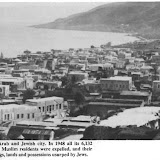
Refugees being forced out of their villages (near Lod and Ramla). "Nakba in Pictures"


1948 UNRWA photo


Israeli soldiers looting an unidentified Jerusalem area Palestinian village in 1948. GPO/AIC photo.


Palestinian refugees separated from their home by the "green line". 1948 UNRWA photo


Israeli Soldiers in abandoned Palestinian home in Qatamoun, West Jerusalem, in 1948. GPO/AIC Photo.

Tuesday, January 30, 2007

Old Newspaper Clippings

Palestine pre-Israel

I've created a photo gallery of some old newspaper clippings of Palestine. Click on the image above to open the gallery.

You can run the pictures as a 'slide show' or just click on the individual thumbnails.

Take some time to read the captions describing the picture contents...you may gain a better understanding of what Palestine was before the creation of the Jewish state and why I (and others) lament the loss of what Palestine was...and what it could have been.

I still believe it's possible to re-Unite Palestine and ALL of it's people as a secular, modern nation.

Tuesday, January 23, 2007

Jewish Like Me

McGill University is one of the bigger University's in Canada and it's campus is here in Montreal. It may actually qualify as an "Ivy League" school. I was going through the McGill Daily paper online and came across this story, "Jewish Like Me" written by Jesse Rosenfeld, a Toronto transplant.

It's a very good article that illustrates the dichotomy of what it is to be a Jew from a North American perspective. As a Palestinian forced to leave his home I am encouraged by this public display of condemnation of Israel's violent past and a call for justice for the Palestinian people.

Here's part of the article:

"Like most kids growing up Jewish, I loved Israel. I identified with the country and saw my Jewish identity expressed in it.

Maybe it was because I found inspiration in an Israeli culture that seemed to focus on youth. I liked how David Ben-Gurion, Israel’s first Prime Minister, referred to the “New Israeli Jew” – strong, committed and independent – as opposed to the idea of a “European Jew” – weak, emasculated, and dependent. Or maybe I wanted to identify with something other than tedious family gatherings in Toronto complete with a grandmother who pinched my cheeks.

Either way, as a short, underweight early teen looking to find a form of community and feeling of empowerment, Israel and its image provided me with a feeling of masculinity. The Israeli myth allowed me to reject the stuffiness of North American Jewish culture while keeping a sense of an imagined community that was still accepted, and even encouraged, by my family and community.

As I explored this more, I began to realize that Zionism was synonymous with a violent colonization and occupation of another people."

>> Read More Here

Thursday, January 18, 2007

'Peel'ing Back History


One of the most dynamic streets in Montreal, my adopted home is Peel Street. It's full of great restaurants, chic shopping and a beautiful park. As a Palestinian I have always felt uneasy with the name 'Peel' (See: Peel Commmission) but in the desire for knowledge I have done some research and discovered some very interesting things about Peel Street.

The street was actually named after a former British Prime Minister The Right Honorable Sir Robert Peel, 2nd Baronet. He was the British PM before Canada was even established as a country, from 1834 to 1835 and then again from 1841 to 1846. With my uneasy feeling suppressed I decided to dig further on who was the guy the Peel Commission was named after and discovered that indeed Lord Peel (William Wellesley Peel) was the Grandson of Robert Peel. His Dad was Arthur Wellesley Peel also a very prominent politician most notable the Speaker of the British House of Commons 1884 to 1895. All of this to say that long before the Peel Commission made it's "decision" vis-a-vis Palestine, there was a long history of elitism.

You've got to think with THAT kind of political pedigree it's no wonder W. W. Peel got it wrong.
"Politics is the art of looking for trouble, finding it everywhere, diagnosing it incorrectly, and applying the wrong remedies." -Groucho Marx

The British should have helped the European immigrants assimilate themselves into Palestinian society while helping the Palestinians to understand Jews came to Palestine to create a new life for themselves and not to steal land and jobs from them. Then before the British left Palestine they should have set them working shoulder-to-shoulder to build a liberated Palestine they could all be proud of...they didn't...


If you're interested here's a live webcam looking down on St. Catherine and Peel Streets.

Tuesday, January 16, 2007

House Buying in Jerusalem


H
appy New Year! (It's not too late is it?) I've been busy.

You'll be happy to know (unless you're a Zionist) that with the new year I've decided to start looking for a place to live back in Jerusalem and came across this listing. The down side is that it's just an apartment and I would prefer to "buy a piece of land" for obvious metaphorical reasons, but man, look at the view...come to think of it it looks exactly like my profile picture doesn't it?!?! Hey, that's cool!

Tell me what you think of the place...

Tuesday, December 19, 2006

No More Taking Sides

Once again I turn to a great radio show on NPR called Speaking of Faith. I heard the story of Robi Damelin who lost her son David to a Palestinian sniper and the story of Ali Abu Awwad who lost his older brother Yousef to an Israeli soldier. But, instead of clinging to traditional ideologies and turning their pain into more violence, they've decided to understand the other side — Israeli and Palestinian — by sharing their pain and their humanity. They tell of a gathering network of survivors who share their grief, their stories of loved ones, and their ideas for lasting peace. They don't want to be right; they want to be honest.

Listen to the show which runs about 53 minutes (.MP3 or Real Audio) and then feel free to comment.

I know that a re-United Palestine, secular and for all of it's people will not be easy, but it is something we NEED to do. It is the only way out of this mess...

Tuesday, December 12, 2006

"Israel needs a wake up call": An interview with Ilan Pappe

When I ordered my copy of "ONE COUNTRY" Amazon suggested a second book to order at the same time and I did called,"The Ethnic Cleansing of Palestine" by Ilan Pappe. The link below is to an interview with Ilan Pappe by a fellow blogger Christopher Brown. Please take a moment to read it as an addition to my post ONE COUNTRY.

"Israel needs a wake up call": An interview with Ilan Pappe

Tuesday, December 05, 2006

ONE COUNTRY

I truly believe that Palestine is meant to be an example to the world of 'unity': Unity of religion, language and a unity point of East/West culture and ideology. And I am glad to find out now that I'm not the only ONE.

I have just discovered the book ONE COUNTRY: A Bold Proposal to End the Israeli-Palestinian Impasse by Ali Abunimah, a fellow Palestinian now living in the US who among many things is a cofounder and editor of the website Electronic Intifada.

About the Book
As the Israeli-Palestinian conflict rages on with relatively new leadership on both sides, we are led to ask what has become a perennial yet only more urgent question -- will this conflict ever be resolved in a way that will finally bring peace to the region? This fall, Metropolitan Books published one of the most controversial approaches to a resolution. Noted expert on the topic and the son of Palestinians who fled the country in 1948, Ali Abunimah makes the radical argument that what is needed is one state shared by Palestinians and Israelis in his new book, ONE COUNTRY: A Bold Proposal to End the Israeli-Palestinian Impasse (Metropolitan Books; November 2006).

Clear-eyed, sharply reasoned, and compassionate, ONE COUNTRY revives an old and neglected idea of sharing the country. Although living together might seem impossible, Abunimah shows how Israelis and Palestinians are by now so intertwined -- geographically and economically -- that no kind of separation can lead to the security Israelis need or the rights Palestinians must have. He reveals the bankruptcy of the two-state approach, takes on the objections and taboos that stand in the way of a binational solution, demonstrates that sharing the territory will bring benefits for all, and asserts that the country can remain a homeland for both Jews and Palestinians. The absence of any other workable option can only lead to ever-greater extremism; it is time, Abunimah suggests, for Palestinians and Israelis to imagine a different future and a different relationship.

More urgent than ever, ONE COUNTRY is a provocative approach to the Israeli-Palestinian conflict, and one that is certain to cause a stir on all sides.

I believe it takes great courage to end the current cycle of: fear > hatred > war > terrorism >
fear > hatred > war ....etc. The only way to get off this track is to try something different...a FREE and re-United Palestine, a secular country for ALL.

Buy the book in Canada
Buy the book in the U.K.
Buy the book in the United States


In the beginning...


NOTE: I feel that my blog has gone too far into the political realm which was never my intention. As part of my effort to bring things back to my story of a Palestinian living in exile I give you this post and hope you will understand my sadness (and sometimes anger) over having to leave my ancestral home because of faulty politics, please consider this a new beginning.

Call me Abu-Issa. I was born in Jerusalem, Palestine in the mid-60's (vagueness for my protection). This is a picture of the hospital I was born into the world from. The Augusta Victoria Hospital which is on the Mount of Olives just East of the Old City. I like this picture because it shows the hospital in the winter with a light dusting of snow something which I have grown very accustomed to here in my new home, Montreal, Canada.
The Augusta Victoria Hospital was formally a German hospice.  Named after
the wife of Kaiser Wilhelm II of Germany, who visited Jerusalem in 1898 and
built the hospital for German Pilgrims. You can see the Judea Desert in the
background of this photo, behind the photographer would be a breathtaking
view of the Dome of the Rock, Jerusalem's visual centerpiece.
Since 1950
the Augusta Victoria Hospital (AVH) has been a project of the Lutheran World
Federation. It's main task has been to provide services for Palestinian
Refugees in cooperation with UNRWA, the United Nations agency that has
been responsible for the refugee-programs in the region since 1948. Today,
the hospital continues to develop services for the Palestinian community,
mostly on a charitable basis.

The sad truth is that I have never been back to this hospital, ever, not even
for the birth of my younger brother (there was an Israeli curfew in effect at
the time, which will be another story for another post). The work they do
there is invaluable to the people of Palestine. (And please note that when
I say "the people of Palestine" I mean ALL the people of Palestine:
Muslims, Christians and Jews). You can support their work by contacting
them here:

Augusta Victoria Hospital
P.O. Box 19178
Jerusalem 91191

Wednesday, November 29, 2006

Life Flows On


I have a new friend, Dandoon, a Palestinian lady who actually lives here in Montreal. Visit her blog.

Her most recent post has inspired me to get back to the roots of this blog as the emotional clearing house of a Palestinian living in Montreal. Now, I'm not saying I will stop discussing and exploring the political side of why I am here in this beautiful city, just that I will try to focus again more on the emotional side of what it is to be a Palestinian...who is not allowed to return home to Palestine...for now...

Thursday, November 23, 2006

Choose To Be FREE

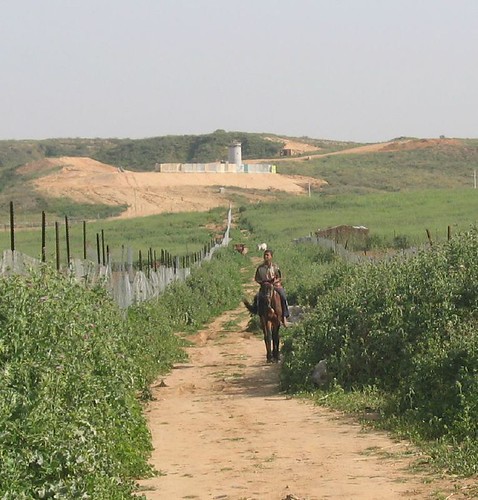
(Photo by Gazagirl: A Palestinian boy rides his horse leisurely in front of an Israeli sniper tower located just across the Israeli border with Gaza.)


This is taken from another blog I frequent for spiritual inspiration:

"Choose to be Free"
by Velcrow Ripper

"Recently one of the comments on my blog stated - ‘one doesn’t choose to be free.’ Kind of like the idea that we are already enlightened, we just need to recognize that we are. Most certainly we are born free - then slowly, we begin to build our prisons, with more than a little help from society. We take a journey in life, away from the kingdom, out into the world, yet one day we can return to freedom.

Freedom, like love, is a choice. We choose to love - though sometimes it seems to just magically appear - falling in love - but we need to create the conditions. We need to open our hearts, our souls even, to the possibility.

Free will is a great gift. What a different game this life would be if humans were forced to be good, forced to do the right thing. How much more meaningful it is when we take the steps ourselves, when we choose liberation, when we choose to unpack all the filters and cultural limitations that stand in the way of us and freedom. I’m not talking about the kind of freedom George Bush is always going on about - his greatly touted freedom, for which he will lay waste to thousands of innocent humans - is by and large a chimera. Freedom does not mean the right to buy more stuff. Freedom does not mean another 100 channels of television.

Freedom means a heart, soul and mind that is liberated from illusion. Liberated from the controlling clutches of the ego. Liberated from the unconscious drives of hatred, agression, fear, desire, attachment, desperate grasping, that turns us into puppets on a string. The pupeteer is the ego. Cut the strings, and you will be free. Free from the constant looping refrains of the past, and free from the desperate striving for the future. Freedom is, in fact, surrender. Surrender, unconditionally, to what ‘is.’ A human being in a prison cell on death row has the ability to be free. It’s not conditional on circumstance. In fact, time and again I have seen incredible breakthroughs happen in the hearts of those who have every reason to contract into a tight ball of fear. For some, the opposite happens in the face of crisis - an opening magically occurs, and true freedom is experienced. Victor Frankl, in Man’s Search for Meaning, wrote that everything can be taken away from us but one thing - the freedom to choose the way we respond to whatever comes our way. He was referring, in this case, to those remarkable survivors of Auschwitz who were somehow able to come through with their spirits intact,and even transformed. With these kind of remarkable examples, how can we, in our own lives, with our own smaller (though by no means unimportant problems), not choose to be free? And once we are free, once we are truly autonomous, we will very naturally be impelled to take action in this world to help others become free, in whatever way is our own true path. Choose to be free - the planet is depending on you."

-------------

As Malcolm X said, "You can't separate peace from freedom because no one can be at peace unless he has his freedom."

Choose a FREE and re-United Palestine! A Palestine for ALL of it's people, whether they be Jew, Muslim or Christian.